


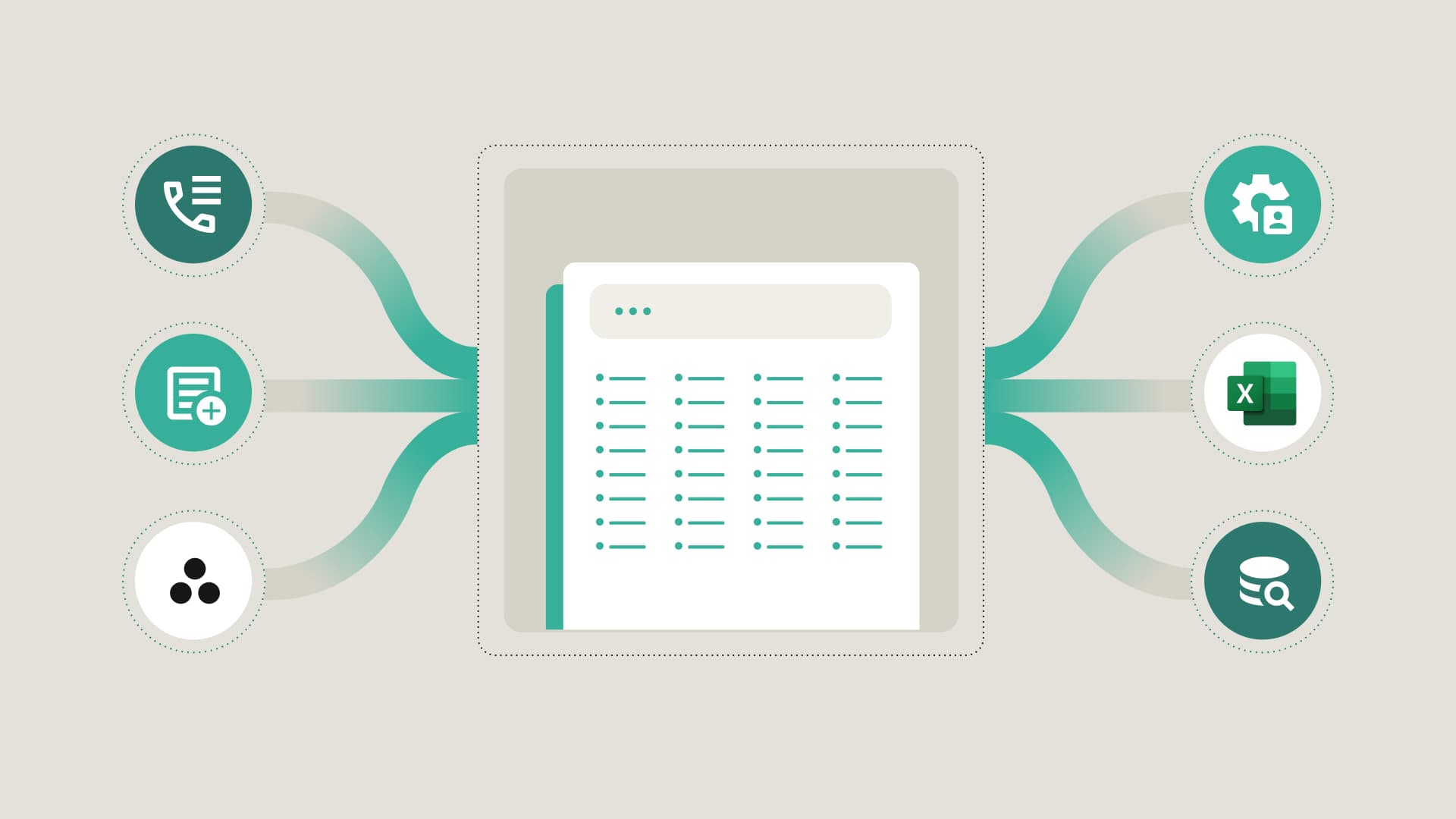
Ask a personal injury paralegal how the day actually goes, and you will hear a version of this: downloading records from a retrieval vendor’s portal and saving them into the file, copying the same update into a spreadsheet, forwarding a client’s text from a personal phone to the attorney’s email. Every one of these steps matters. The trouble is that a person has to do them at all — they exist only to bridge tools that do not talk to each other, and in most firms someone is bridging them all day. That is the problem this article is about, and the reason so many PI firms are now consolidating intake, case files, documents, and calendars into one platform.
Contents
What software do personal injury firms actually use?
Nearly every firm runs case management software at the center of the practice. The real sprawl sits around it: a standalone AI tool for medical records, an outside vendor for record retrieval, a texting app for client messages, spreadsheets for settlement numbers and reporting, and outsourced paralegal help when workload spikes.
Each of these lives outside the case management software. Each has its own login, its own subscription, and its own copy of the case. Add them up, and many firms are paying for and coordinating six or more tools. None of these were bad decisions, which is exactly why the problem is easy to miss.
Why do personal injury firms end up with so many disconnected tools?
Firms rarely plan it this way. Tools accumulate one reasonable decision at a time, each added to solve a single problem as it appeared. But because none of them were built to work together, the firm itself becomes the integration: re-uploading records into the AI tool, forwarding files to a paralegal who cannot see the case, checking that the calendar and the case notes still agree, and re-entering client details wherever they are missing.
So the vendor list is not the result of one bad decision. It is several good decisions that were never connected, and these multiple tool subscriptions are not the only problem.
What do six disconnected tools actually cost you?
The visible cost is money: six subscriptions and six renewal dates. The larger costs are time and accuracy: the hours your team spends moving information between tools and the errors that slip in while they do so.
Copying details from one tool into another, saving the same file in two places, checking that both copies still match: this is slow, repetitive work that adds nothing to the case. It is also where accuracy quietly erodes, because every manual transfer is another chance for the versions to drift apart.
The consequences are not abstract. A demand can go out missing months of treatment records because the records arrived but never made it into the part of the file the demand was built from. And the most common way firms miss a statute of limitations is exactly this: the deadline was tracked outside the case, in one person’s calendar or a spreadsheet, where the rest of the team could not see it.
What does consolidating into one system look like?
Consolidation means the whole case lives in one place. Instead of spreading a matter across a case tool, a records vendor, an AI tool, a texting app, and a paralegal’s inbox, everything stays in one case file: the intake that opened it, the documents and signatures, the medical records, the deadlines, the client messages, and the settlement numbers.
This is the idea behind CloudLex, an ecosystem built exclusively for personal injury firms. An ecosystem is not a bundle of tools you link yourself. It is one connected system whose parts are designed around the same case file. CloudLex is built on three pillars:
- The CloudLex Platform, where you build, manage, and grow your practice, with every case managed from accident to resolution.
- Lexee AI, responsible AI embedded in the system. Because it works from within the system of record, it reads the entire matter, including records, documents, and notes, to build medical summaries and treatment chronologies and answer questions about the case.
- Paralegal Services, trained PI paralegals with over a decade of experience who handle work such as medical record retrieval, chronologies, and document drafting, delivered directly into the case file. Firms of every size use them, from solo practitioners to large practices.
The table below shows how the tools firms bolt on around their case management software come together in one system.
| What firms usually add | Why firms add it | What the CloudLex does instead |
|---|---|---|
| General case management software | A place to work the cases | The CloudLex Platform: every case from accident to resolution, in one case file |
| Separate intake/lead CRM | Track and convert new leads | Intake that converts to a matter in one click, with no re-entry |
| Outside record-retrieval vendor | Chase providers for medical records | Retrieval requested, tracked, and delivered inside the case file by Paralegal Services |
| Standalone AI tool | Read records, build treatment chronologies | Lexee AI, embedded in the system, reading the entire matter from within |
| Separate calendars and spreadsheets | Track filing dates and the statute of limitations | Deadlines tracked in the matter, visible to the whole team |
| Texting app on personal phones | Text with clients | Secure two-way messaging inside the system, where the firm and client message each other and every message is saved to the case |
| Accounting/settlement spreadsheets | Track disbursement and firm numbers | Settlement and disbursement handled in a built-in settlement calculator, inside the case |
| Outsourced paralegal help | Extra hands when workload grows | Paralegal Services working inside the same case file, for firms of every size |
Because Lexee AI is embedded in the system, it does not work from copies. It reads and accesses the entire matter from within CloudLex, including records, documents, and notes, so a treatment chronology or an answer to the case reflects your firm’s complete, current file. Nothing is uploaded to a separate tool, and nothing comes back stale.
Paralegal Services follow the same principle. The work is human-in-the-loop: trained PI paralegals do it, with AI used for speed, and it is raised, tracked, and delivered inside the case file your team already works in. There is no exporting files and no re-explaining the case. The Platform, Lexee AI, and Paralegal Services are three pillars working on one case file all inside one ecosystem.
What firms say
“CloudLex brings communication, document storage, and task management together in one place. I no longer have to jump between multiple programs to find what I need. It is all there, clearly labeled and easy to reach.”
Alba Clarisa, Legal Assistant
“We’re able to handle about 40% more cases than our previous software, because we can organize our documents and automate our internal processes.” Michael B. Cohan, Cohan Law PLLC
“Others try to be everything to everyone.CloudLex is made by personal injury teams for personal injury teams.”
Beau Correll, CEO & Managing Attorney of Correll Law Firm® and Big Bubba™ Injury Law
How do you migrate without losing your data or your team?
This concern keeps many firms on tools they have outgrown, and it is fair. Migration takes work, and a busy firm cannot afford downtime or a team that resists new software.
Two things make migrating easier than it seems. First, migration is a one-time event, and you are not doing it alone. CloudLex’s own in-house team moves your data, and they have migrated many firms off many different case management systems, so whatever you are using today, you are in experienced hands. Because the Platform, Lexee AI, and Paralegal Services are pillars of the same ecosystem, growing later means turning on more of what you already have, not moving again.
Second, because the ecosystem is built exclusively for PI firms, it speaks your language: matters, liens, chronologies, statutes of limitations. That makes it intuitive from the first day, so your team can start working and become productive with minimal training.
How do you choose a personal injury case management system?
The most important question is whether the system was built for personal injury, or built for every practice area, which PI firms then have to adapt to their work. Generic legal software was designed around billing-by-the-hour transactional practice. Personal injury is different: contingency economics, medical evidence at the center of the case, and matters that run from accident to resolution over years. A system built around how PI cases actually move fits the practice without adaptation.
A few questions will separate your options. Do the matter, the records, and the AI all stay in one system, or does the AI copy your data into a separate system? Are client intake, client communication, and settlement part of the same case file? And will the system still fit as the firm grows, or will you be migrating again in three years?
Consolidating intake, case files, documents, and calendars into one system
Running a personal injury firm is hard enough without spending the day moving information, and going back and forth, between tools that do not talk to each other. The tools are not the problem. The separation is.
Consolidation ends that. When intake, case files, documents, deadlines, communication, and settlement live in one system, and the AI and paralegal support work inside that same case file, the connecting work disappears. What replaces it is consequential: demands built on complete records, deadlines the whole team can see, and a practice that grows without adding tools.
See your firm in one connected system
You became a personal injury attorney to fight for people through the hardest moment of their lives, not to keep software tools in sync. When the CloudLex Platform, Lexee AI, and Paralegal Services work as one ecosystem, the connecting work disappears, and that time goes back to your clients and their cases. See what your practice looks like on one system.
Key takeaways
- Most PI firms accumulate six or more tools one reasonable decision at a time. The hidden cost is that the firm itself becomes the connection between them.
- The subscriptions are not the real problem. The larger costs are time and accuracy: hours spent moving information, and the missed records and deadlines that manual transfers cause.
- Consolidating into one personal injury system keeps intake, case files, documents, deadlines, communication, and settlement in one place, so there is no connecting work left to do.
- Lexee AI is embedded in the system, so it reads the entire matter from within CloudLex and works from your firm’s complete, current file. Nothing is uploaded to a separate tool.
- Migration is a one-time event handled by CloudLex’s in-house team, and because the ecosystem grows with you, you will not need to move again.
Frequently asked questions
What is personal injury case management software?
It is software built to run a personal injury practice from accident to resolution. It handles intake, case management, documents, statute of limitations and deadline tracking, client communication, settlement, and reporting. Unlike general legal software, a system built for personal injury treats these parts of a case as core functions, not add-ons.
Can one system really replace six separate tools?
For most personal injury firms, yes. A connected system combines case management, intake, documents, e-signature, deadline tracking, communication, and settlement into one case file. In CloudLex, the Platform, Lexee AI, and Paralegal Services work together, so your firm does not have to connect separate tools itself.
How is built-in AI different from a separate AI tool?
A separate AI tool copies your case data into its own system and works there. Lexee AI is embedded in CloudLex and reads the entire matter from within the system, so its output reflects your firm’s complete, current file. Nothing is uploaded elsewhere.
Can clients and staff communicate inside the system?
Yes. The firm can message clients and clients can message the firm from within CloudLex, and every message stays saved to the case instead of living in a separate texting app or inbox.
Will migrating to a new system disrupt my firm?
Migration takes planning, but it happens once, and CloudLex’s in-house team moves your data. Because the Platform, Lexee AI, and Paralegal Services are one ecosystem, growing later adds to the same case file instead of requiring another migration. And because the system is built exclusively for PI, it is intuitive, so most teams need minimal training.