





You have a strong personal injury case. Liability is clear. Your client followed up with every healthcare provider they were referred to. You have witnesses, photos, and a cooperative client ready to move. The only thing standing between you and a real settlement conversation with the insurance companies? The records still have not arrived.
Six weeks after the initial medical record request. Still waiting.
Medical record retrieval is one of the most underestimated bottlenecks in PI practice. It’s the foundation of every personal injury case you’ll take – and when the process breaks down, the cost shows up in delayed settlements, stalled negotiations, and clients waiting longer than they should.
Contents
Why medical records are the foundation of every personal injury case
In a personal injury case, the medical record is your story. It documents the injury, connects it to the incident, and gives you the evidence you need to push insurance companies toward fair compensation. Without complete records, you are arguing from anecdotes.
The types of records that matter go well beyond the ER report. You need treatment records, billing records, imaging results, specialist notes, and documentation from every health care provider your client saw both before and after the incident. The “before” records matter because insurers will point to pre-existing conditions whenever they can. A complete picture closes off that line of attack.
In medical malpractice cases, the dynamic shifts further. The medical record is the legal case. Every note, every order, every date stamp carries weight.
For personal injury lawyers handling mass-tort litigation, the complexity multiplies fast. Tracking relevant records across dozens of providers and multiple clients simultaneously is nearly impossible to manage in-house without a dedicated system. Something critical will eventually fall through.
The bottom line: Incomplete records mean weak demands. Weak demands mean slower settlements, which doesn’t serve your clients.
What actually happens when you submit a medical record request
Here is what the medical record retrieval process looks like when it runs smoothly – and why it so rarely does.
Step one
Identify the right health care provider and prepare a valid, signed authorization. Every provider has slightly different authorization requirements. A missing field or expired date gets your record request rejected and might even reset the clock entirely.
Step two
Submit the medical record request. Depending on the provider, that means an online portal, fax, or physical mail. Some medical professionals have moved entirely to electronic format; others still work through backlogs of paper records.
Step three
Follow up. Then follow up again. This is where the time-consuming process sets in for most firms. A paralegal managing attorney requests that across 25 active cases, can’t give every outstanding request the attention it deserves. Follow-ups slip. Requests stall. The retrieval process loses momentum.
Federal regulations under HIPAA compliance rules govern how records must be requested and released by every health care provider. Errors in authorization preparation don’t just cause delays – they force your team to restart the entire process. A retrieval specialist handling these requests daily knows what each provider requires and how to avoid those pitfalls. A paralegal handling medical record requests as a secondary task is working at a structural disadvantage.
Some companies have provided outsourced medical record retrieval services for years – reflecting a recognition across law firms in the United States that this work is better handled by dedicated teams than by staff juggling competing priorities.
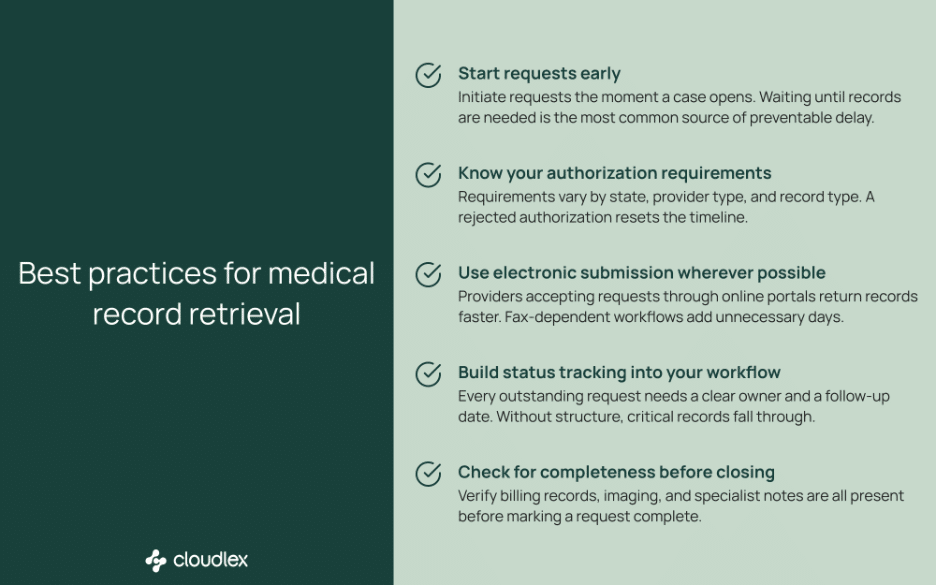
Best practices for medical record retrieval in PI practice
Regardless of how your law firm handles retrieval today, these best practices apply.
Start requests early. The moment a case opens, identify every health care provider your client has seen and initiate the medical record request immediately. Waiting until records are needed before requesting them is the most common source of preventable delays in a personal injury case.
Know your authorization requirements. Requirements vary by state, provider type, and record type. A rejected authorization resets the clock. Know what each health care provider requires before submitting, or work with a client specialist or retrieval specialist who does.
Use an electronic medium wherever possible. Providers that accept requests through an online portal or electronic medium return records faster. When a health care provider offers delivery in electronic format, take it every time. Fax-dependent workflows add unnecessary days to every attorney request.
Build status tracking into your workflow. Every outstanding request needs a clear owner and a follow-up date. Without that structure, critical information falls through. Legal professionals who skip this step tend to find out that records are still outstanding mid-negotiation, which is the worst possible time.
Check for completeness before closing the request. Billing records excluded from the initial response, missing imaging pages, reports cut off mid-document – these are more common than they should be. A completeness check before records reach the attorney is a best-practice standard that consistently pays off. When something’s missing, treat it as the highest priority and go back to the provider immediately.
For high-volume firms and those running mass tort operations, applying these standards consistently in-house becomes genuinely difficult without dedicated support. The volume alone makes it hard to treat every medical record request with the attention it deserves.
Should your law firm outsource medical record retrieval?
The signs that in-house retrieval has hit its ceiling are recognizable: paralegals spending the majority of their day on provider outreach, inconsistent follow-up, personal injury cases stalling while records lag, and a caseload that keeps growing without any realistic path to absorbing the additional volume.
Across the United States, a growing number of personal injury lawyers are moving away from both in-house retrieval and disconnected third parties. The traditional record retrieval service model – external online portals, email status updates, records delivered as attachments – still leaves your legal team doing manual work. Staff still tracks requests, chases updates, and uploads records into case files. The administrative burden shifts slightly but doesn’t disappear.
A modern record retrieval solution works differently. A dedicated client specialist team manages the entire retrieval service – authorization preparation, multi-channel provider contact, persistent follow-ups, issue escalation, and organized delivery directly into the matter. Real-time updates let attorneys check the status by provider without interrupting the people doing the work. Every law firm should have that visibility as a default, not something that requires a status call to get.
For firms looking for a cost-effective solution that scales with volume – without hiring, training, or managing additional staff – integrated retrieval changes how the practice operates. Firms handling standard PI files and those running high-volume mass tort cases have both found meaningful improvements in case velocity once retrieval moves out of paralegal hands and into a dedicated record retrieval service.
Stop letting record retrieval slow your cases down
Medical record retrieval determines how fast your legal cases move, how strong your demands are, and how much capacity your legal team has for work that requires legal judgment.
The personal injury lawyer who treats retrieval as a real system – not something that gets handled when someone finds a free moment – moves cases faster, builds stronger demands, and gives clients a better shot at fair resolution.
CloudLex’s Paralegal Services is built specifically for personal injury lawyers, with medical record retrieval embedded directly inside the CloudLex ecosystem. Requests are submitted from the matter. Status is tracked by the provider. Records are delivered organized, indexed, and ready for demand prep, treatment chronologies, or settlement calculations, without duplicate data entry or separate logins.
If your law firm is still running the retrieval process the hard way, it’s worth calculating what that’s costing you. Not just in hours, but in personal injury cases delayed and clients left waiting.
CloudLex gives personal injury lawyers a smarter, more cost-effective solution. Request a demo and see how medical record retrieval works inside the platform.
Ready to see it in action?