




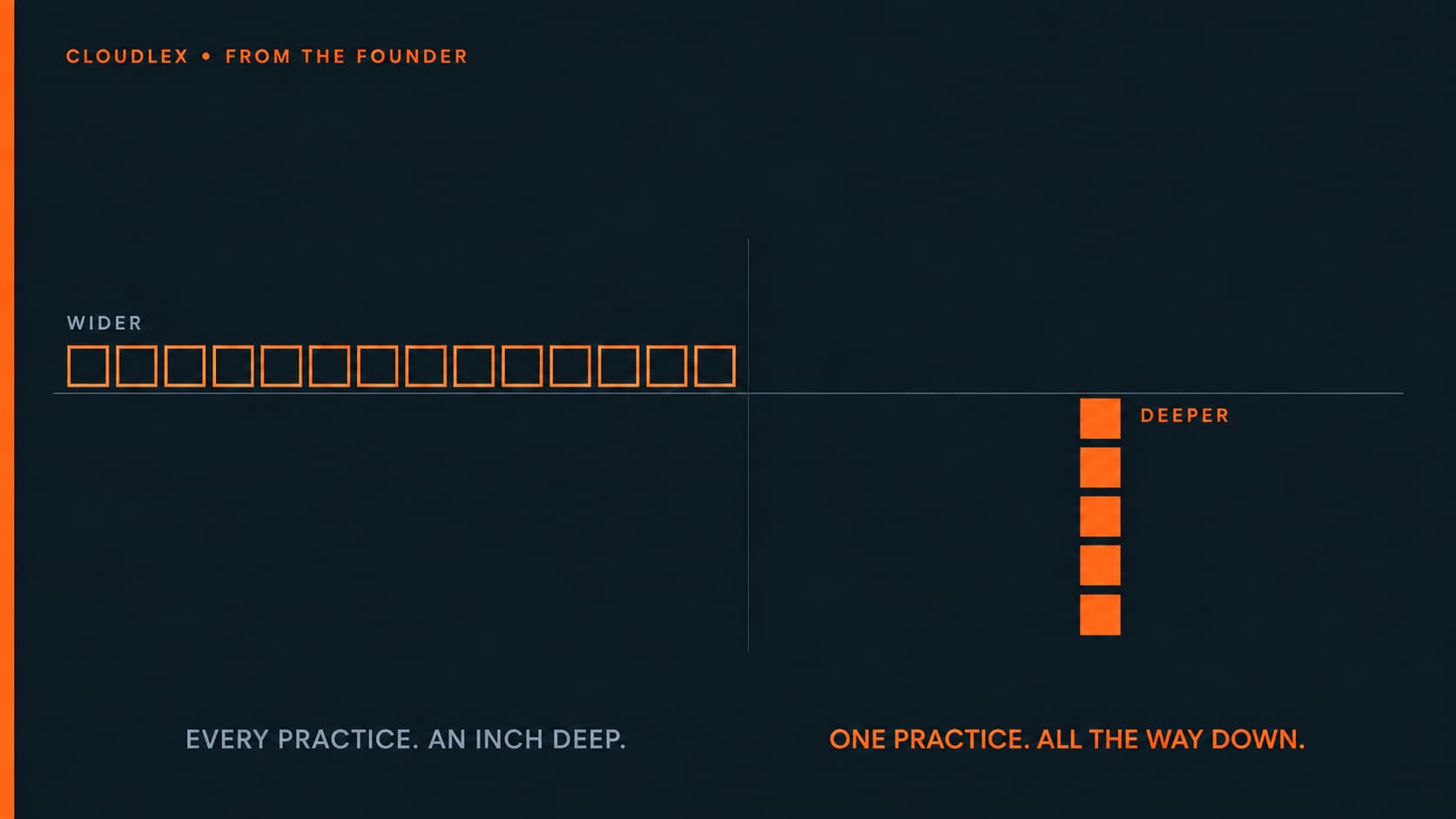
Forty years, five rebuilds, and the one question that tells you whether a software company wants what you want.
Most personal injury case management systems were never designed for personal injury. They were designed for law firms in general and then sold to you.
That is no accident.
This is how they have been developed for more than forty years. The same design and the same underlying idea, upgraded five times across five technology revolutions. Each time, that idea was carried forward rather than rethought for the practice you actually run.
And this article is my attempt to say what purpose-built actually means, and why it is critical for a plaintiff personal injury law firm. Built for a case that is a story rather than a project. For work that moves between you and providers, experts, adjusters, defense counsel and the court, to name only a few. For one place where everything true about a case lives and the work actually gets done. For a firm that puts its own money behind the cases it believes in, and gets paid once, at the end. And for the way your people already work.
Contents
Same personal injury, two firms, two different businesses.
Take two firms. One is pure-play plaintiff personal injury, one hundred percent focused on it, ready, able and willing to take a case to trial. The other is a good general practice firm that handles personal injury alongside commercial contracts, real estate closings and family law.
Do you think those two firms take on the same kinds of personal injury cases? The same kinds of plaintiffs? Do you think they are organized the same way, staffed the same way, run the same way?
I think not. They are not the same business.
Different goals. Different economics. Different staffing. Different definitions of a good month. Not better, not worse. Different.
Now stay inside personal injury and narrow it all the way down, to motor vehicle accident claims alone. One firm runs high volume, works pre-litigation, settles on strong demand letters and pursues volume. Another takes fewer cases and is genuinely prepared to take them all the way to trial. The same motor vehicle accident category. Two completely different operations, two different sets of people, two different measures of success.
Every one of those distinctions is obvious to any personal injury lawyer reading this. You would never confuse those firms, and you know why better than I do.
How and from where the clients came to you is different. What it costs in marketing and advertising to bring them to you is different, and the gap between two firms on that one line can be a factor of ten. How and if the case gets financed is different. How the case is staffed is different. How the providers are paid is different. What a good month even means is different. And how you build, manage and grow the practice is different.
So here is the question. If those firms are that different from each other, what exactly is a software platform offering all of them, in the same way, with the same functionality and the same features, and still marketing itself as serving every one of them?
The intuitive answer is the right one. By definition that software has to be generic enough to fit every one of them. Which means it offers only what they all have in common.
A case file, or a project. A task list. A calendar. Emails, and somewhere to put documents. And many times, billing and invoicing.
Everything that makes your firm different from the firm down the road was not left out by accident. It was set aside on purpose.
And the purpose is a perfectly sound one. A software company casting the widest possible net is trying to serve as many seats, as many practice areas and as many geographies as it can reach. That is a good business; it is how most software companies are built, and I have no quarrel with it.
Which leaves the thing actually worth noticing. The software company your firm relies on may not grow in the direction that keeps serving your need for the best possible outcome, one case at a time, for one injured person at a time.
Not good, not bad. Simply not aligned.
The software companies never changed their thinking about your practice.
None of this happened by conspiracy. It happened by inheritance.
Software for managing law firm cases goes back to the early 1980s. If you go back far enough, you remember the first one your firm bought. It ran on DOS, on a beige computer, the screen was green, and exactly one person in the office really understood it. If you do not, ask whoever has been there longest. They will remember, and they will remember who that one person was.
Since then the technology underneath it has changed five times.
Windows arrived. The software was rebuilt for Windows. Then came client-server, with the system sitting on a server in the back room and everybody's computer wired into it. Rebuilt again. Then the internet, and now it had to run in a browser. Rebuilt again. Then the cloud. Rebuilt again. Now AI is here, and it is being rebuilt one more time.
Notice who those rebuilds were for. Not your practice. Your law practice, personal injury at its core, did not change in 1995 because Windows shipped. Each of those five rebuilds happened for the same reason. A new technology paradigm arrived, and every software company had to adapt to it or disappear.
And those software companies had to move fast. The fastest way across was to carry the existing product over and give it a new face. That is not laziness. It is entirely rational business strategy. Redesigning, building from scratch, is expensive, time-consuming, and risky. Copy-pasting the earlier product and giving it a facelift is not.
So the technology changed five times. The model underneath the product never did, and neither did the way any of it answers what a personal injury practice actually needs.
Just look at the underlying design that survived all five upgrades. Your case remained a file, or a project. Work remained a list of tasks. Dates went on a new calendar. Documents went on a new drive. Time got billed and invoices churned out. That is forty-year-old law firm case management thinking, and it is still what these systems are designed around.
Let me be clear about something, because I am a technologist before I am anything else. I am not discounting what software has done for the operational efficiency of the legal industry, and I am not arguing against using technology. Of course not. A dictaphone was better than shorthand on a legal pad. Every one of these systems replaced a wall of manila folders and a legal pad, and every one of them was better than what it replaced by a wide margin.
The point is narrower than that. Every one of those transformations carried forward the same general purpose functions and features. A file with tasks attached works for a real estate closing, an immigration petition, a divorce and a trucking case, all at the same time.
It fits everybody because it describes nobody.
It was built for a world where the hard part was remembering things. Where did we put that document, what is due next week, who was supposed to call the client back. Those are real problems and it solved them.
But in your practice, remembering has never been the hard part.
I would happily bet that if somebody put a handful of accident photographs in front of you with no names attached, you would tell them who the plaintiff was in a few seconds. That you could send a paralegal to a file from three years back and tell them which motion to pull out of it and roughly what it argued.
That is not unusual. Every good trial lawyer I have met carries their cases around with them.
What nobody can carry is all of them at once. Where every case in the firm stands today. Which ones moved this week and which ones sat still. Which are waiting on a provider, which are waiting on an adjuster, which are waiting on the court, and which are waiting on somebody inside your own office who has not gotten to it yet.
That is the hard part. And it is not a memory problem at all. It is what happens when a case does not move the way a list of tasks moves.
So why, in forty years, did nobody build for that?
Nobody was ever paid to build for you.
Let me be blunt about the answer, because it is not a mystery and you do not need me to name anybody. Run a search for personal injury case management software. You already know the usual suspects who will show up. And yes, we are right up there among them.
But look closely and you will see broadly three types of firms.
One, the general purpose case management firms, carrying the same design forward all these years. Two, firms that were genuinely built for you once, and have since been taken over by private equity conglomerates. Three, the cloud and AI based arrivals.
The first I have already described. Let me take the second.
Software that was genuinely built for personal injury once, bought by a private equity firm and then rolled together with three or four other products. An accounting system. A payment system. Something for documents. What you are sold is one platform. What you are running is several systems stitched together.
The objective is a different one. Buy several legal software products. Put them under one roof. Take out the duplicated cost. Sell more of them to the same customers. Assemble a portfolio and sell it on to a larger private equity firm. That play is not new. It has been run more than once in this industry, and anybody who has been around long enough has watched one of those rollups happen up close.
There is nothing wrong with it as a business. But it is a very different objective from spending the next ten years solving harder and harder problems for a personal injury firm. And over time, the product follows the business.
The third set is the billion-dollar success stories, backed by very large venture funds, selling into legal practices of every kind, everywhere in the world. A different play with the same consequence for you. Their objective is reach. And reach and depth pull in opposite directions. Some of them even started in personal injury. Look at their expansion path since.
The newest addition to that set is the so-called AI native ones. A new engine dropped into the same forty-year-old chassis, and a conviction, in my opinion more a narrative than a finding, that AI can turn your experience, your expertise and your skills into an algorithm. I have written about that elsewhere and I will not repeat it here.
You will notice a common growth pattern across many of these companies. Raise a large round. Build a broad product. Market it as though nothing else in the category exists. Take the main stage and tell a room full of trial lawyers that the practice of law has been reimagined. Sign firms quickly, because the growth rate is what the next round gets priced on. Reach a critical mass of subscribers. Position the company for the next financing, acquisition or exit. Growth becomes the story. And once rapid growth is the story, the company has every reason to keep widening the market it can sell into.
None of that is wrong, or unusual, or anybody's crime. It is how most venture-backed software gets financed, capitalized and incentivized. But notice what none of it pays for. Going deeper into one practice.
Building a vertical solution is a choice. It is a deliberate decision to differentiate from the rest of the crowd by going deeper, and only deeper. All the resources, all the time, all the energy, spent solving problems for one category and no other. That takes patience, and a long-term view of where value comes from. It is the difference between expanding the market you serve and expanding the problem you solve.
One thing is clear. Software investment has long followed the clients with the deepest pockets. Enterprises. Insurance carriers. Defense firms sitting on insurance technology infrastructure. Corporations.
Not the small and mid-sized law firm fighting for somebody who got injured. Somebody who lost mobility, lost earnings, and lost the productive life they were going to have.
The plaintiff side of this universe was never the priority. Smaller, regional, fragmented. Never the focus of the Microsofts or the Oracles of the world.
Look at what that bought the other side of your cases. Insurance carriers have had serious, large, purpose built systems for a very long time. Colossus has been valuing bodily injury claims for American carriers since the 1990s. They invested in valuing claims, in managing claims, and in understanding their own exposure across millions of files at once.
The plaintiff side got the same old project management tools with a fresh coat of paint every ten years.
Or worse. Software firms that were acquired, rolled into something bigger, and somewhere along the way the product that once knew your practice became one product among many. You put your trust in it. You spent years building your practice around it. And then you discovered that the company was no longer growing in the same direction you were. So you go looking for one option that grows with you, commits to your practice, and stays with you from the day you hang your own shingle to the day you are running an established firm, and you cannot find it.
The tell.
So how do you find one? Not from a demo, and not from a brochure.
But there is a way for a personal injury lawyer to work out whether a software company's growth strategy and product roadmap are actually aligned with the goals, the objectives and the needs of their own firm. And you can do it entirely from the outside, without knowing the first thing about software programming or any of the jargon that comes with it.
You already do this with law firms. Visit any firm's website and within a minute you know whether it is a pure-play personal injury practice or a general practice. The practice areas listed. Who they hired. What they talk about first.
You can read a software company exactly the same way. Look at the practice areas its platform serves. Look at how the product has grown. Look at what it has actually released.
Watch which direction that software company grows its product and its reach.
A company whose design and strategy allow it to go deeper into one practice grows by going deeper. More of the case. More of the process. More of what actually happens between the accident and the resolution.
A company whose strategy is built for horizontal growth grows the other way. It goes wider. One morning there is an announcement. Now serving family law. And immigration. And workers' compensation. And criminal defense.
That announcement is always presented as ambition, and in fairness it usually was the strategy all along. Horizontal reach. More practice areas, more seats, more countries. It is also worth considering that it might be a limit showing.
Either way it is not the question that matters to you. The only question that matters to your firm is whether anybody is going deeper into personal injury. Whether a software company also wants to conquer the rest of the legal world is their business, not yours.
So try it from the other direction. Think about what it would take you to add a real estate practice, or criminal defense, to your own firm. Not the sign on the door. The operations. Different intake, different people, different deadlines, different money, different everything. You would not call that easy.
Now look at a software company that can add a whole practice area to its product and announce it in a release note.
If it is that easy for them, it is because there was never very much personal injury in there to begin with. Breadth runs on generalization, built to fit the masses. Depth runs on specificity, built with a sharp focus.
Easy means shallow.
And it gets worse from there, not better. Once the product serves four practices, anything that only personal injury needs has to compete for priority against the needs of every other practice the company serves. Every addition pulls the product a little further toward the middle, toward the things every practice has in common, and a little further from the case sitting on your desk this morning.
Forty years of that, and you arrive exactly where we started. A case file. Some tasks. A calendar. And many times, billing and invoicing.
You can run this test on anybody, and I would encourage you to run it on us as well. Look at what a company has actually shipped over the last three years, not what it has said. Did the work go deeper into one practice, or wider across many?
The answer tells you what that software's design permits. Which is a more useful thing to know than anything in the brochure.
The work on a personal injury case does not live entirely inside your office.
Software that treats a case as a list of tasks has made one quiet assumption, and the assumption is wrong. It assumes that the entire case work lives inside your office, and that it only moves when somebody in your office moves it.
Very little of a personal injury case works that way.
Look at what a case is waiting on, stage by stage. Early on it is responses from your client, and their records, sitting with providers, and the bills and the liens behind them. When the demand goes out it is an adjuster, with their own file, their own supervisor and their own quarter to worry about. After suit it is defense counsel, first on the answer and then on discovery. Then it is the court, on a motion that gets decided when the court decides it. Then it is a mediator's calendar. And at the end, even the settlement is not between two parties. It is between you, the adjuster, the lienholders, the providers, the referring attorney and a client who has waited three years for it.
Your team is chasing every one of those, and chasing them is most of what a good case manager does all day. The point is not that the firm is passive. The point is that a task list has no way to show the difference between work that is sitting on your desk and work that is sitting on somebody else's, three hundred miles away, with no obligation to you at all, and in many cases with every reason to be slow and to produce what you asked for on the last day the rules allow.
And because every piece is held by a different outside party, a case does not have one status. It is moving on three fronts and sitting completely still on two others, at the same moment. Ask an experienced case manager what the status of a case is and watch the pause before the answer, because the honest answer is that it depends which part you are asking about.
A task list cannot hold that. A task list wants one thing to be next.
Now multiply it by four hundred open files.
There is no end date either. You can put a target on a case, and everyone in the room knows the target is a guess dressed up as a plan. And resolution can arrive from almost anywhere. A case can settle pre-suit, after depositions, at mediation, on the courthouse steps, or in the middle of trial.
There is no fixed sequence through it, and that is why no single standard project management playbook has ever survived a real personal injury caseload. There is no standard repeatable plan, with predictable timelines and predictable outcomes, for how a personal injury case runs from the first day to the last. Standardizing these cases to that degree is extremely challenging, if not impossible, even for a vertical solution provider. Let alone a general-purpose one.
And that is not a gap somebody forgot to fill. It is the nature of the work. These are not immigration petitions, with a government form, a statutory requirement and a process laid out in advance. This is litigation, and litigation runs on case law. The body of law itself keeps moving. A decision handed down in another courtroom can change what your case is worth, what you are able to argue, and what you should have been preserving two years ago. Statutory work has a fixed shape. Litigation never does.
The sequence is contested, and the other side gets a say in it.
Then the difference that matters most, and it has nothing to do with structure. It is the goal.
A project wants to be finished. On time, on budget, closed. Every project tool ever built rewards closing items faster, because in a project, faster is better.
A case does not want to be finished. It wants to be worth what it should be worth. And there are plenty of moments where the right move is to slow down on purpose. To let the damages finish developing. To let the other side spend real money on their own experts and depositions. To wait until they have something at stake. Sometimes it comes down to who blinks first.
So a tool whose entire logic is closing items faster is not neutral in this practice. It is pushing, quietly and constantly, in the direction that costs your client money.
A case is not a project. It is a negotiation, conducted over two or three years, against parties you do not control. You win it by managing it as a negotiation, not by running it as a project plan.
Why a personal injury case cannot live in four systems.
Start where the case actually starts. Not at intake. Before that.
Somebody fills out the form on your website at eleven at night. Or the phone rings and it is a person who has been in a wreck and is not sure whether they even have a case. Or a colleague in your referral network forwards you an email with three lines in it and an attachment. Or a client you settled three years ago calls because his sister has been hurt.
Four different doors, and every one of them creates something the firm will need much later. Where this case came from. Who to thank. Whether there is a fee share. What it cost you in marketing to be found online. Whether this person has already spoken to two other firms.
And notice the hour on the first one. Your practice does not get to call it a day at five o'clock, because an accident does not keep office hours. The firm that is responsive, attentive and present in somebody's most distressing and vulnerable moment is usually the firm that earns their trust.
Then it moves. Qualification, and everything you learned about coverage and liability while you were deciding whether to take it. Sign-up. Intake, and the long first conversation where the client tells you what happened to them. Investigation. The police report, the photographs, the witness nobody else called. The provider list, and the records requests that go out against it.
Then the records themselves, arriving out of order for as long as the treatment continues, which depending on the severity of the injuries can be six months or it can be several years. Ongoing treatment is normal in this practice. The case is very often being built while the client is still being treated.
The medical chronology assembled from those records. The bills, and the liens sitting behind the bills. The demand, which goes out when the client has reached maximum medical improvement or when it is strategically right to send it, not simply when the paper stops arriving. The response to that demand, which tells you something about this adjuster you did not know before. Suit. Discovery. Depositions. Mediation. And if it comes to it, the story you put in front of a jury.
Every one of those stages is built out of the ones before it. Not loosely. Directly. The medical chronology is only as good as the records behind it. The demand is only as good as the medical chronology. Your negotiation posture is built out of what the demand produced. The story a jury hears is built out of all of it.
Nothing in that chain is independent. Each stage inherits from the previous one.
Now put those stages in four different places. The intake CRM. The case management system. The medical records portals. The plaintiff communication tool. And then the spreadsheet somebody built in 2019 that the entire firm quietly depends on, which nobody counts as a system at all.
Here is what happens at every boundary between them.
Data crosses. Context does not.
The medical record moves from one system to the other. The reason your paralegal flagged page four hundred and twelve does not. The offer gets recorded. Why you refused it does not, because nobody ever wrote that down, it was a conversation in a hallway. The deposition date transfers. What you actually learned in that deposition stays in one person's head.
And notice what happened to the very first thing. By the time the case matters, three years in, nobody can tell you which of those four doors it came through, what you paid to open it, or who is owed a call when it resolves.
So the firm ends up holding four partial versions of the same case. None of them are wrong, exactly. None of them are complete, consistent or current. And there is somebody on your payroll whose real job, whatever their title says, is going over all the details in five different systems and reconciling them.
It also gets worse as the case gets older, which is exactly backwards, because a case is worth the most when it is oldest.
And you are not billing for any of this. You are financing it.
There is a second difference underneath everything I have described, and it is the one legal software accounts for least.
A corporate firm sells hours. It records time, applies a rate, sends an invoice, and collects. Money moves every month and a client pays it. Essentially, every legal expense management and accounting system built for law firms is built around that cycle, because that is how most of the rest of the profession gets paid.
You do none of it.
You invest in and finance a case. Filing fees, experts, depositions, records, investigators, trial preparation, and often the client's living situation while they are out of work. That is not overhead. That is your own capital, often your own personal credit line, committed to one matter, for years, on an outcome nobody promised you and that you still pursue with full conviction and the intent to go out and win.
That takes more than a lawyer's drive. It takes the spirit and grit of an entrepreneur.
Which makes the person running a personal injury firm something closer to an entrepreneur carrying a portfolio than an attorney running a practice. You hold a book of cases at different stages, with different amounts committed and different times to resolution, and you are deciding constantly which one takes another twenty thousand dollars and which one has reached the end of what it can be built into. That is not how an associate at a defense firm is asked to think, and nothing built for that associate was designed to help.
So consider what your ledger actually is. Costs do not attach to a matter with a billing rate. They attach to the case, and within it to a plaintiff, and frequently to a specific provider. The ledger does not close monthly. It runs for three years and reconciles exactly once. There are no receivables to chase, because there is nothing to collect until the end. Every piece of that apparatus exists to get one moment right.
That moment is disbursement. One check arrives and it is not revenue. It has to be taken apart, and every line has to be correct. Costs advanced. Liens and provider balances, negotiated down one provider at a time. Referring counsel. Co-counsel, on terms agreed three years earlier. The client. Then the fee. Your client will read that settlement statement more carefully than any document you have ever handed them, and it is not an invoice. No invoicing software will produce it.
Fee sharing deserves its own sentence. Referral relationships are how a large part of this practice actually works. The arrangements are governed by rules that differ by state, and they are exactly the thing most likely to be sitting in somebody's memory or in an email from three years ago. A system that cannot record the agreement when it is made, carry it for the life of the case, and apply it at disbursement is asking your firm to remember something it should never have been asked to remember.
Even the question of who sees what is different here. The case ledger needs to be visible to the people running the case. What you are actually willing to accept, and what you told the mediator, is not the same category of information. Most systems treat all of it as finance, with one permission.
And inside the ledger itself the work is already split. A paralegal records the day-to-day case expenses and asks for approval when something needs it. The managing partner, or the accountant, keeps the case-level books and decides what the case gets next. Operational spending and financial decisions are two different jobs, done by two different people, on the same case.
Time and billing do matter in your firm, but not for the reason it exists in general legal case management software. You want to know where your people's effort is going, because capacity is the constraint on how many cases you can carry well. And on a referred case, you may need to show what your firm actually did, because in many states how a fee gets divided has to line up with the work performed or the responsibility assumed. Neither of those is an invoicing question, and the products that lead with it are answering a question you never asked.
You are writing a movie script. Your software is constructing a commercial building.
Look at what these systems are actually organized around, whether they were built for every practice or sold specifically as personal injury case management software.
Stages you complete. Tasks you close. A checklist for each phase. Deadlines that push a case from one stage into the next. Some of them will even show you a percentage telling you how complete a case is.
That is construction thinking. It is a construction project schedule with legal words printed on it.
And putting up a building really is a project. The foundation is poured, the concrete sets, it is inspected, it is signed off, and the crew moves on. Nobody goes back to look at the foundation. Each stage has a defined start, a defined finish and a defined outcome, and when a stage is done, it is done and out of sight.
A personal injury case is nothing like that. It is closer to writing a movie script than to putting up a commercial building. A case is a story being developed.
It starts with a few plain facts. A date, an intersection, a vehicle, an injury. Over the next two or three years it gathers depth. What the treatment actually did to this person's day-to-day life. What they stopped being able to do. The job that went. The wedding they missed. What the second surgeon said that the first one never did. And it builds toward the moment it gets told, to an adjuster, to a mediator, or to a jury.
Nothing in it is ever finished. A fact from the first week can become the most important fact in the case in month thirty, because of one answer in a deposition. The intake notes matter at mediation. The photograph nobody thought much about at the time is the one that opens the trial.
You never move past the foundation. You keep going back to it, and it keeps changing meaning as the rest of the story arrives around it. A line from the opening scene turns out to be the whole picture, and only because of something that happens in the third act.
Which is worth sitting with, because it is easy to miss. A product can have personal injury in its name, in its marketing and on every page of its website, and still be built on the idea that a case is a building going up. The label is positioning. The thinking underneath is what determines whether the software can hold your case, and the thinking underneath is usually forty years old.
So purpose-built cannot mean that the words personal injury appear somewhere in the product. It has to mean the system was designed around what a case genuinely is. A story that accumulates rather than a structure that completes. Held up by parties you do not control. Where nothing is ever finished and the meaning of everything keeps moving, right up until the day it resolves.
Which is why a personal injury firm needs two things from a system, and they are not the same thing.
One source of truth. Everything that is true about this case, all of it still live, all of it in one place, visible to everybody from the intake specialist to the trial attorney.
One source of action. What happens next, decided and carried out in the same place where that truth lives.
Many firms have neither. Some have the first without the second, which produces a firm that knows a great deal and does very little with it. The information is all there, beautifully organized, and the follow-up still depends on somebody remembering.
And both have to fit the way a personal injury firm is actually organized, which is not how any other practice is organized.
An intake specialist, a records clerk, a case manager, a paralegal, an associate, a trial attorney and a managing partner all touch the same file, and every one of them has a completely different relationship to it. One qualifies. One requests. One organizes. One analyzes. One decides. One carries the client through the worst year of their life. One answers for all of it.
A system built on the idea that a case is a project knows none of that. It knows users, and permissions, and a settings screen. Which means somebody inside your firm has to sit down and describe your practice to the software, field by field and rule by rule, and then describe it again every time you change how you work. Worse still, you end up creating your own custom fields just to capture information that every personal injury case in the country generates.
At that point you have become the product designer. Unpaid, and permanently.
The close.
Let me come back to where this started.
A high-volume practice is not a trial practice, even on the same motor vehicle accident. You have always known this.
What you have been asked to accept for forty years is that none of it matters very much, because underneath it all a case is a file with some tasks attached.
It is not, and you have always known that too.
A personal injury case is a story built over years, out of facts you do not fully control, held up by people who do not work for you, where nothing is ever finished and the thing that looked minor in month one turns out to be the case in month thirty. You do not run that with a checklist. You run it the way you run a negotiation, because that is what it is.
I am not arguing that you deserve better software, although you do. I am arguing something narrower and harder to dismiss. A practice this specific was always going to need a system built for it, and it was never going to arrive from an industry being paid to do something else.
So the question I would put to any firm looking at this is not which product is best.
It is whether the company on the other side of the table wants what you want.
You can answer that from the outside, without sitting through a demo. Look at what they have actually built over the last three years. Look at which direction they grew. And look at whether the thing on your screen understands that a case is a story, or still thinks it is a building going up.
Run that test on us as well. I would rather be measured by it than talk around it.
Which brings me to the two words this whole article has been circling.
Purpose built.
It is worth reclaiming, because it describes something real and specific, and because a personal injury firm has every right to insist on it.
So let me say what I believe it has to mean.
- Built for a case that is a story being developed, not a project waiting to close.
- Built for work that moves between you and providers, experts, adjusters, defense counsel and the court, rather than sitting inside your office where a task list assumes it lives.
- Built so that everything true about a case sits in one place, and the work happens in that same place.
- Built for a firm that puts its own money behind the cases it believes in and gets paid once, at the end, out of a single recovery that then has to be divided.
- And built around the way your people actually work, without anybody in your office having to explain your own practice to it, field by field.
That is a demanding standard, and meeting it requires a decision that very few software companies are free to make. It means building for one practice and declining every other one.
We made that decision a long time ago, and we are glad to be measured against it.
You have waited forty years. You are allowed to ask for it.
Dev Shrotri
Dev Shrotri is the Founder and CEO of CloudLex, a connected ecosystem purpose-built for plaintiff personal injury law firms. He has spent over a decade building technology for this practice and writes about the future of personal injury practice, responsible AI adoption, and the strategic decisions facing firms as legal technology evolves. He holds a Master's degree in Computer Science and Engineering from the University of South Carolina, where his research on multi-agent based intelligent software systems was published with Springer-Verlag, and an MBA from Columbia Business School, New York.
Follow Dev on LinkedIn for more of his perspective on personal injury practice and legal technology: linkedin.com/in/dev-shrotri