





Personal injury lawyers didn’t get into this work to spend their afternoons sorting through medical records, rebuilding the same demand letter structure for the fifteenth time, or drafting routine client updates. But for most PI firms, that’s where a significant portion of the week goes – and it compounds as caseload grows.
AI technology is changing that calculus. Not theoretically – right now, in practices handling the same case types yours does. This post covers what AI tools are actually doing in personal injury law today, where they deliver the most value, how they affect client outcomes, and what to evaluate before adding them to your workflow.
Contents
What AI Is Actually Doing in Personal Injury Law Right Now
Generative AI and AI-powered tools are already embedded in the workflows of legal professionals across the country – for drafting, summarizing, researching, and communicating. The legal industry has moved past the question of whether this is worth paying attention to. Personal injury lawyers who haven’t started building familiarity with these tools are already behind peers who have.
In personal injury law specifically, the strongest use cases center on the work that consumes the most time without requiring attorney-level judgment: reading medical records, building treatment chronologies, drafting the structural elements of demand letters, managing client communication volume, and handling intake. These are the time-consuming tasks that pull legal professionals away from strategy, negotiation, and advocacy.
What AI doesn’t do is replace the judgment that makes a strong PI attorney. It handles the groundwork, reading, organizing, drafting, and summarizing, so attorneys can apply their expertise where it actually matters. Natural language processing enables legal AI tools to interpret documents much as a person would, at a speed no person can match.
Lexee AI, built directly into CloudLex, reflects what purpose-built AI looks like for personal injury firms. Rather than routing data through a third-party platform, Lexee reads from existing case files and returns output – summaries, drafts, chronologies – directly into the matter. No system switching, no duplicate data entry, no separate AI vendor to manage.
The Tasks AI Handles Best in a PI Practice
Medical record review and summarization
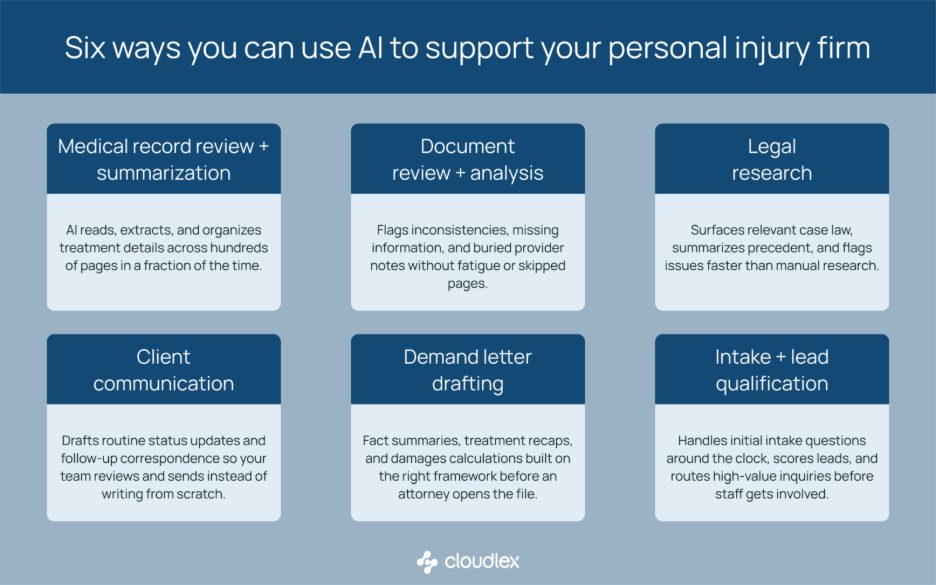
Reviewing hundreds of pages of medical records to build a treatment chronology is one of the most time-consuming tasks in PI work. AI-powered tools read, extract, and organize treatment details – provider visits, diagnoses, gaps in care, key dates – in a fraction of the time required manually. Across a 40-case docket, that’s a meaningful shift in how your team’s hours get spent.
Document review
Reviewing legal documents for relevant facts, inconsistencies, or missing information is precisely the kind of repetitive task AI handles reliably. It doesn’t get fatigued, it doesn’t skip pages, and it doesn’t miss a provider note buried deep in a records packet.
Legal research
AI tools surface relevant case law, summarize precedents, and flag issues faster than manual research. For personal injury firms running high case volume, that speed compounds quickly across the docket.
Client communication
AI-driven tools draft routine status updates, follow-up correspondence, and client-facing responses. Your team reviews and sends rather than writing from scratch, which matters when client interaction volume is high, and responsiveness directly affects client satisfaction.
Demand letter drafting
A strong demand letter still requires attorney judgment on liability framing, damages strategy, and negotiation posture. But the structural foundation – fact summary, treatment recap, damages calculation – is exactly where generative AI earns its place. With the right AI solution, you’re not opening Microsoft Word to a blank page. You’re reviewing and refining a draft that’s already built on the right framework.
Intake and lead qualification
AI-powered virtual assistants handle initial intake questions around the clock, gather basic case details, score leads, and route high-value potential client inquiries before a staff member gets involved. Your team’s attention goes where it should – to the cases most worth their time.
How AI Affects Client Experience and Case Outcomes
The operational efficiency gains matter. What they produce for clients matters more.
When AI handles the time-consuming tasks, attorneys have more capacity for client interaction that drives satisfaction and outcomes. Clients on contingency want to know their attorney is on top of the case, communicating proactively, and moving toward resolution. That’s harder to deliver consistently when the legal team is buried in administrative tasks.
Faster demand letter turnaround means negotiations start sooner, which directly affects how long clients wait for resolution. Producing a complete, well-supported demand package in less time isn’t just an internal efficiency win. It’s a more effective form of client advocacy.
Predictive analytics is an area worth watching as it matures. Using historical data from past cases, AI solutions can help estimate settlement ranges, flag case risk, and inform negotiation strategy. It won’t replace attorney judgment, but as a reference point for calibrating case positioning and setting realistic client expectations, it’s a powerful tool with real potential.
Client communication consistency also improves when AI tools are part of the workflow. Faster responses, more regular updates, and fewer dropped touchpoints all contribute to a better client experience – and to the referrals that follow when clients feel well-represented throughout.
What to Evaluate Before Adding AI to Your Practice
AI-powered tools produce confident output. That’s what makes them useful – and what makes oversight non-negotiable. Generative AI can generate plausible, well-structured language that’s factually wrong or missing critical context. Every demand letter draft, medical summary, and piece of legal research needs attorney or paralegal review before it goes anywhere near a case. The AI accelerates the work; your team ensures its accuracy.
Ethical concerns in the legal profession around artificial intelligence are real and still developing. Confidentiality, competence, and the supervision of AI-generated work are all areas state bars are actively addressing. Any AI solution handling client data needs to meet the same regulatory compliance standards as the rest of your practice. Know your jurisdiction’s current position before you build these tools into your workflow.
Not all AI solutions are built the same. Generic generative AI platforms don’t know the difference between a mass tort and a premises liability case. They don’t understand what a PI demand letter needs to accomplish, or how to read a treatment chronology for gaps in care that matter to an insurer. Legal AI tools built specifically for personal injury law understand the context – and that shows in the quality and reliability of the output.
The best AI solutions work inside your existing case management system. Separate logins, manual uploads, and disconnected platforms are the primary reason generic AI tools create as much friction as they remove. When AI output lives in the same system as the case it came from, the workflow is cleaner and the risk of human error in moving data between platforms goes away.
AI Won’t Replace Personal Injury Lawyers. It Will Separate the Effective Ones from the Exceptional Ones.
What makes a strong personal injury lawyer hasn’t changed: judgment, client advocacy, the ability to understand what a client has been through and fight effectively for what they deserve. AI doesn’t touch any of that.
What it does is clear the path to doing it well. More time for case strategy. More time for clients. Better outcomes across a docket that isn’t bogged down in work that doesn’t require a law degree. Personal injury firms building AI into their practices now have a real competitive edge – not because the technology is novel, but because efficiency compounds: one hour saved per demand letter across 50 active cases is significant.
Leverage AI with Lexee by CloudLex
Lexee AI is built directly inside CloudLex – designed specifically for the personal injury case workflow. Medical record summaries, treatment chronologies, demand letter drafting, intake qualification, and case Q&A all occur within your case management system, tied to the specific matter and ready for attorney review. No separate AI vendor, no duplicate data entry, no switching between platforms.


